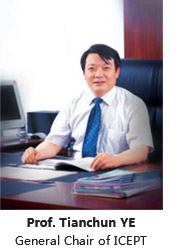
The International Conference on Electronic Packaging Technology (ICEPT) is one of the largest and most cohesive packaging technology conference in Asia. 2026 27th International Conference on Electronic Packaging Technology (ICEPT) will be held in Xi'an, China, from August 5th to 7th, 2026. The conference is hosted by Institute of microelectronics, Chinese Academy of Sciences, Xi'an Jiaotong University, IEEE-EPS and CIE-EMPT. It is organized by the School of Microelectronics of Xi'an Jiaotong University, National Center for Advanced Packaging Co., Ltd., Shaanxi Semiconductor Industry Association and Beijing Herogees Consulting Company. ICEPT held in China every year, conference topics including Packaging Design, Manufacturing Technologies, R&D, and Photonics, MEMS, System Integrated Packaging etc..., since it inaugurated in 1994, ICEPT has been held by Tsinghua University, Peking University, Fudan University, Harbin Institute of Technology, Huazhong University of Science and Technology, Hong Kong University of Science and Technology and other universities for 26 sessions. ICEPT attracts a large number of domestic and foreign universities, research institutions, electronic packaging manufacturers participate, more than 800 Well known experts, scholars and business people from about 20 countries and regions are expeccted to attend ICEPT 2026.
School of Microelectronics of Xi'an Jiaotong University
 School of Microelectronics traces its roots to the “Applied Physics” program established at Xi'an Jiaotong University in 1959, one of China's earliest centers for semiconductor research and talent training. Its discipline “Microelectronics and Solid-State Electronics” is a national key discipline under both Project 211 and Project 985, with full master's, doctoral, and postdoctoral programs. In 2004, it was approved as a National Integrated Circuit Talent Training Base. The Department of Microelectronics was founded in 2007, followed by the establishment of School of Microelectronics in 2015. In 2019, graduate education and research platforms moved to the Western China Science & Technology Innovation Harbor. The first-level discipline “Integrated Circuit Science and Engineering” was launched in 2022, and the School was approved as a “Specialized and Innovative Industry Academy” in 2023.
The School now has over 60 faculty and technical staff, including 15 professors, 23 associate professors, and 29 PhD supervisors. It is home to one CAE academician, two CAS academicians (dual-appointed), and several national and provincial high-level talents. Thirty-two industry experts serve as external mentors, forming a well-structured faculty team.
With deep roots in microelectronics education and research, the School maintains extensive collaborations with leading universities, institutes, and enterprises worldwide. It offers the “Integrated Circuits & Computer Engineering Experimental Class” (Strong Chip Program), the “Power Semiconductor Elite Class,” and the “Aviation Chip Elite Class” in partnership with industry. Upholding the spirit of the “Westward Relocation,” the School is dedicated to education, research, and innovation, contributing significantly to China's microelectronics talent development. Many alumni have become industry leaders.
Research focuses on IC design, micro-/nano-devices and processes, wide-bandgap semiconductors, electronic functional materials, devices, packaging, and testing. More than 20 research platforms have been established, including national-level teaching and research bases, along with seven provincial-level labs and engineering centers such as the Shaanxi Key Laboratory of Electronic Devices and High-End Chips. The School also co-founded the Xi'an Jiaotong University Microelectronics Innovation Institute in Hefei and the Changzhou IC & Intelligent Technology Research Institute, fostering multiple emerging tech startups.

Introduction to Xi'an
Xi'an, known as Chang'an in ancient times, is the capital city of Shaanxi Province and one of China's Four Great Ancient Capitals. Since the 1980s, Xi'an has gradually developed into a vital hub for science and technology, education, industry, and culture in western China, playing a crucial role in driving the economic development of China, particularly the central and western regions. As the capital of thirteen dynasties in Chinese history, Xi'an is a convergence of the brilliant Chinese civilization. Its cultural treasures range from the world-renowned cultural heritage site, the Terracotta Army of Emperor Qin Shi Huang, to the Giant Wild Goose Pagoda, the Ancient City Wall of the Ming Dynasty, Huaqing Pool, and the Bell and Drum Towers. Moreover, the modern charm of the Datang Ever bright City and Qujiang New District blends seamlessly with its historical essence, creating a unique interplay between history and innovation in the city. Xi'an is also the starting point of the ancient Silk Road, endowing it with a rich urban narrative and a strong international cultural atmosphere. Beyond its profound historical heritage, Xi'an is famous across the country for its culinary delights: roujiamo (Chinese hamburger), liangpi (cold rice noodles), yangrou paomo (lamb soup with baked buns), hulutou (pork intestines soup), guantang baozi (soup dumplings), Bingfeng soda, and more. Each of these dishes represents the "flavors of Xi'an" that tantalize the taste buds. With its abundant scenic spots and distinctive Guanzhong-style cuisine, Xi'an has become one of the most popular tourist destinations in China.